
Sylvan City Landscaping
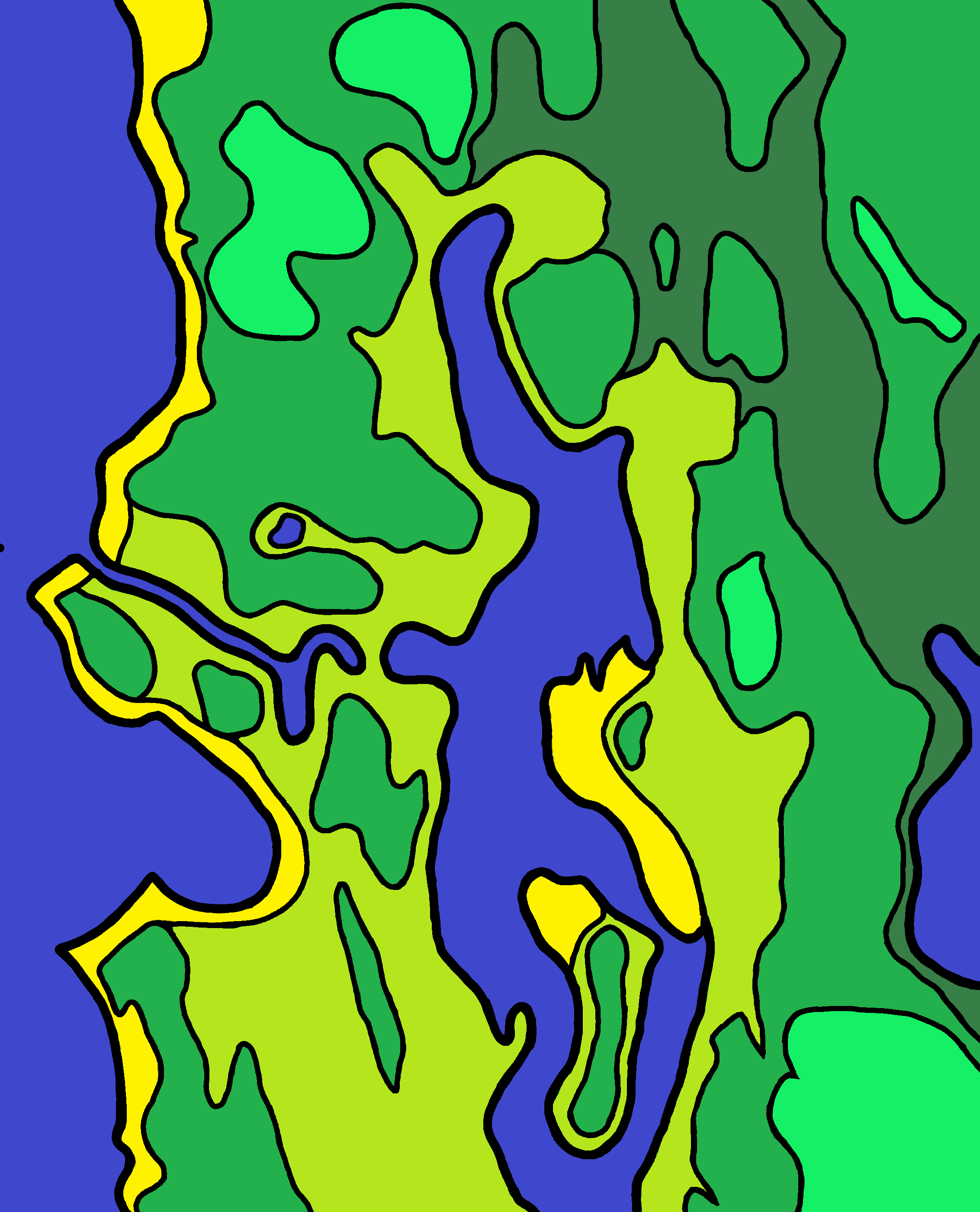
Use the map below to find out more about your local gardening conditions! Click on your town or neighborhood to see a desciption of your soil type.
llllllll Can Canna! With winds off the water, no frost pockets and average annual precipitation as low as 32 inches, areas colored in gold below can risk planting perennials hardy to only 20 degrees with protection; hardy to 15 degrees for shrubs and trees. Plants that suffer from excessive wet winter soil like eucalyptus and chinquapin are also possible.
llllllll Kraken's Playground. Other lower elevations with substantial lake/sound influence are a bit cooler and often much wetter than west shores; average annual precipitation varies from 34 to 40 inches. Local lowlands recieve frosts heavier than surrounding areas. Feel safe planting perennials hardy to 15 degrees; hardy to 10 degrees for shrubs and trees.
llllllll The Hills. Elevations from 250ft to 500ft. Average annual precipitation generally high: 36-38 inches. Cold snaps last longer and are a bit more severe than below. Feel safe planting perennials hardy to 15 degrees with protection; hardy to 10 degrees for shrubs and trees.
llllllll The Heights. Elevations over 500ft; precipitation 38-40 inches annually. Cold snaps last longer and can be much more severe than below, but generally bring an insulating layer of snow. Feel safe planting perennials hardy to 10 degrees; hardy to 5 degrees for shrubs and trees.
llllllll The Valley. Lower elevations without lake influence. 38-40 inches precipitation annually. Local lowlands recieve frosts heavier than surrounding areas. Feel safe planting perennials hardy to 10 degrees with protection; hardy to 5 degrees for shrubs and trees.
West Seattle, Delridge & FauntelroyUrban land: 10%Alderwood: 62%Alderwood-Everett: 25%Anthraltic Xerothents: 3%
Mount Baker, Beacon Hill, Columbia City & Rainier ValleyUrban Land: 13%Alderwood: 71%Alderwood-Everett: 12%Anthraltic Xerothents: 4%
Capitol Hill, Central District & Madison ParkUrban Land: 7%Alderwood: 74%Alderwood-Everett: 26%Anthraltic Xerothents: 3%
SeattleUrban Land: 87%Alderwood: 13%
U-District, Laurelhurst, Ravenna & WedgewoodUrban Land: 21%Mukilteo Muck: 1%Alderwood: 73%Alderwood-Everett: 5%
Ballard, Crown Hill, Greenwood & Green LakeWater: 5%Urban Land: 7%Alderwood: 80%Alderwood-Everett: 8%Alderwood-Kitsap: 1%
Maple Leaf, Lake City & Bitter LakeUrban Land: 10%Alderwood: 78%Alderwood-Everett: 7%Anthraltic Xerothents: 2%Alderwood-Kitsap: 3%
ShorlineUrban Land: 6%Alderwood: 78%Alderwood-Everett: 12%Anthraltic Xerothents: 2%Alderwood-Kitsap: 2%
Mountlake Terrace & BrierUrban Land: 4%Alderwood: 78%Alderwood-Everett: 3%Everett: 6%Kitsap: 1%Indianola: 1%McKenna: 3%Norma: 4%
Lake Forest Park & KenmoreUrban Land: 6%Alderwood: 54%Alderwood-Everett: 18%Everett: 8%Kitsap: 5%Indianola: 5%Norma: 2%Ragnar-Indianola: 2%
BothellUrban Land: 2%Alderwood: 55%Alderwood-Everett: 2%Everett: 13%Kitsap: 8%Indianola: 4%McKenna: 3%Norma: 2%Mukilteo Muck: 3%Snohomish: 5%Arents: 3%
Woodinville & Cottage LakeUrban Land: 2%Alderwood: 70%Everett: 9%Earlmont: 2%Kitsap: 1%Indianola: 6%Norma: 3%Ragnar-Indianola: 1%Mukilteo Muck: 3%Snohomish: 3%
KirklandUrban Land: 1%Alderwood: 50%Everett: 5%Arents: 13%Kitsap: 11%Indianola: 9%Norma: 1%Ragnar-Indianola: 9%Mukilteo Muck: 1%
RedmondUrban Land: 2%Alderwood: 41%Everett: 14%Arents: 5%Earlmont: 8%Kitsap: 6%Indianola: 12%Norma: 1%Mukilteo Muck: 5%Snohomish: 4%Pilchuck: 2%
MedinaUrban Land: 3%Alderwood: 47%Arents: 22%Bellingham: 8%Kitsap: 11%Indianola: 4%Mukilteo Muck: 5%
BellevueUrban Land: 4%Alderwood: 37%Arents: 28%Everett-Alderwood: 5%Everett: 9%Beausite: 7%Bellingham: 2%Kitsap: 3%Mukilteo Muck: 5%
Alderwood:Landscape: Glacial drift plainsLandform: Hills, RidgesLandform position: SummitParent material: Glacial drift and/or glacial outwash over dense glaciomarine deposits0 to 7 inches: gravelly sandy loam7 to 59 inches: very gravelly sandy loamDrainage class: Moderately well drainedMost common soil type in Seattle area; most level or gently sloped areas above 100ft. Light soil amendment wanted for trees and shrubs; appreciates composted mulch to add organic matter.
Everett:Landscape: Glacial drift plainsLandform: HillsLandform position: Shoulder, backslopeParent material: Sandy and gravelly glacial outwash0 to 1 inches: slightly decomposed plant material1 to 60 inches: very gravelly sandy loamDrainage class: Somewhat excessively drainedSecond most common soil type in Seattle; most steeper slopes. Amend heavily with planting; mulch with bark to prevent erosion.
Anthraltic XerothentsLandscape: Glacial drift plainsLandform: HillsLandform position: Shoulder, backslope, summitParent material: Glacial drift and/or glacial outwash over dense glaciomarine deposits over human-transported material0 to 26 inches: gravelly sandy loam26 to 59 inches: very gravelly sandy loamDrainage class: Moderately well drainedUncommon and often interspersed with alderwood; treat the same.
Arents:Landform: Till plainsParent material: Basal till0 to 26 inches: gravelly sandy loam26 to 60 inches: very gravelly sandy loamDrainage class: Moderately well drainedHuman-transported backfill; in Seattle area parent material is usually alderwood; treat the same.
Beausite:Landscape: FoothillsParent material: Till over residuum from sandstone0 to 19 inches: gravelly ashy sandy loam19 to 38 inches: very gravelly sandy loam38 to 42 inches: bedrockDrainage class: Well drainedUndisturbed soil on gentle slopes. Soil amendment wanted for trees and shrubs; appreciates composted mulch to add organic matter.
Bellingham:Landform: Drainageways, DepressionsParent material: Alluvium0 to 11 inches: silt loam11 to 60 inches: silty clay loamDrainage class: Poorly drainedDepressions or flat areas near lake level; plant only water-lovers.
Earlmont:Landform: Flood plainsParent material: Diatomaceous earth0 to 44 inches: silt loam44 to 60 inches: stratified muck to very fine sandDrainage class: Somewhat poorly drainedFound east of Totem Lake; plant only acid-lovers and mulch thickly with bark to add depth.
Indianola:Landscape: Glacial drift and outwash plainsLandform: Terraces, Kames, EskersLandform position: RiserParent material: Sandy glacial outwash0 to 1 inches: slightly decomposed plant material1 to 17 inches: loamy sand17 to 60 inches: sandDrainage class: Somewhat excessively drainedFound on small local highs among alderwood soils. Amend heavily while planting or seeding; compost mulch heavily to add organic material. Once amended, one of the best soils in area.
Kitsap:Landscape: PlainsLandform: TerracesLandform position: TreadParent material: Glacial lacustrine deposits0 to 10 inches: silt loam10 to 59 inches: silty clay loamDrainage class: Moderately well drainedSlopes at lower elveations. Limit disturbance to prevent erosion. Mulch with bark to prevent erosion.
McKenna:Landscape: Till plainsLandform: Depressions, DrainagewaysParent material: Basal till0 to 33 inches: gravelly silt loam33 to 60 inches: very gravelly sandy loamDrainage class: Poorly drainedDepressions among gravelly soils; plant only water-lovers.
Mukilteo Muck:Landscape: Glacial drift plainsLandform: DepressionsLandform position: DipParent material: Herbaceous organic material0 to 6 inches: muck6 to 79 inches: mucky peatDrainage class: Poorly drainedPlant only semi-aqueous plants.
Norma:Landform: Flood plainsParent material: Alluvium0 to 10 inches: ashy sandy loam10 to 60 inches: sandy loamDrainage class: Poorly drainedExcellent, fertile soil for plants that can stand high winter water table. Mulch thickly with bark to add depth.
Ovall:Landscape: FoothillsLandform: Mountain slopesParent material: Glacial drift over residuum with volcanic ash in the upper part0 to 36 inches: gravelly ashy loam36 to 40 inches: BedrockDrainage class: Well drainedSlopes at higher elevations. Amend heavily for garden plants; mulch with bark to avoid erosion.
Pilchuck:Landform: Low stream terraces, Flood plainsParent material: Gravelly and sandy alluvium0 to 38 inches: loamy fine sand38 to 60 inches: gravelly sandDrainage class: Excessively drainedAmend heavily while planting or seeding; compost mulch heavily to add organic material.
Ragnar:Landform: Terraces, Kames, EskersParent material: Glacial outwash0 to 27 inches: ashy fine sandy loam27 to 60 inches: loamy sandDrainage class: Well drainedFound on small local highs among alderwood soils. Amend heavily while planting or seeding; compost mulch heavily to add organic material. Once amended, one of the best soils in area.
Snohomish:Landform: Flood plainsParent material: Alluvium1 - 0 to 11 inches: silt loam11 to 17 inches: clay loam17 to 27 inches: mucky peat27 to 60 inches: loamy fine sandDrainage class: Poorly drainedPlant only water-lovers and don't get too attached to plants during heavy rains.
We are committed to a fully organic approach in everything we do.
Serving: Seattle, Shoreline, Mountlake Terrace, Kenmore, Bothell, Woodinville, Redmond, Kirkland & Bellevue
Top :: (206) 847-7080 :: Alex@sylvancity.us :: Services :: Plant Selector